
City of York Council faces a £32.3m budget gap by 2028/29 and wants to ask the government for help. Adult social care is the biggest pressure; some services may stop.
City of York Council expects to be £32.3m short over the next two years, and its finance director wants to ask the government for help. The figure is in a Medium Term Financial Strategy update that goes to the council’s Executive on Tuesday 3 November.
The report warns that some services are likely to shrink and some may stop altogether. No cuts are named yet. Councillors will not decide the 2027/28 budget until the Executive meets in January and Full Council in February 2027.
The numbers
The gap builds up year by year. Each figure is the shortfall after the council has assumed the maximum council tax rise:
| Year | Gap that year | Running total |
|---|---|---|
| 2027/28 | £18.1m | £18.1m |
| 2028/29 | £14.2m | £32.3m |
| 2029/30 | £2.9m | £35.2m |
The biggest pressures in the forecast are:
- adult social care: £3.7m of price rises in 2027/28, plus £7.5m of extra growth over two years to cover the service’s running overspend
- £8m less government funding in 2027/28 and £7.3m less in 2028/29
- the cost of borrowing for building projects, £3m in each of the next two years
- pay, assumed at 3% a year after this year’s 3.3% award
- £0.5m for the closure of Castle Car Park and £0.6m because planned library savings have not been made
Adult social care now takes 46.5% of council spending, up from 40.5% two years ago. With children’s services at 21.5%, the report says 68% of the budget goes on those two statutory services.
Asking the government for help
The Executive is asked to let Debbie Mitchell, the Director of Finance, open talks with the Ministry of Housing, Communities and Local Government’s Financial Resilience Team. The report says this is to explore “Government assistance, loans or temporary support” while the council restructures.
Two outside reviews were commissioned this year. The Local Government Association found the council’s forecasts “robust, transparent and realistic”. It also warned that unless savings and transformation are delivered, the council “may need to consider Exceptional Financial Support to avoid the risk of a Section 114 notice”. A Section 114 notice is a council’s formal declaration that it cannot balance its books.
A second review, by the Chartered Institute of Public Finance and Accountancy, found the council “in short term financial control”. It noted only about £1.5m of reserves above the minimum prudent level. That review has not been published yet.
This year is already over budget. The quarter two finance report on the same agenda forecasts a £5.16m overspend for 2026/27, £7.85m of it in adult social care. Chief officers must now sign off any spending over £5,000.
Why York says it is underfunded
The report argues the government’s Fair Funding Review hit York twice:
- a new needs formula weighted towards deprivation cut York’s share of national council funding from 0.288% to 0.261%, which the council puts at £12m a year
- the government now assumes councils charge a “notional” council tax; York’s Band D, £1,817 this year, is £148 below that level, which the report says costs £7.8m in funding
On the government’s own measure, core spending power, York has £942 per resident this year. The report says that is the lowest of any unitary council except Windsor and Maidenhead. It is forecast to be £941 in 2028/29, while the England average rises 7.3% over the same period.
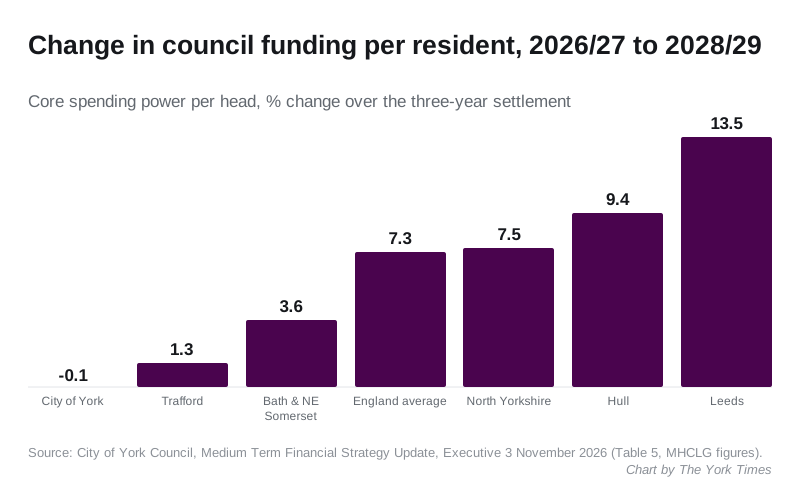
If York’s funding rose by the England average, the report says, there would be over £14m more to put towards the gap.
What the council could do
The report sets out three options for councillors:
- a major restructure, stopping services the council does not have to provide by law and cutting back others, which would mean fewer staff
- a much smaller building programme funded by borrowing
- working with the voluntary sector and the NHS to run services at lower cost to the council
The council has already saved almost £40m over six years, including £14.3m in 2024/25.
What it means for you
- Council tax: the forecast assumes a 4.99% rise in each of the next three years, the most allowed without a referendum. That would take York’s Band D charge for the council from £1,817 to about £1,908 in 2027/28. Our York council tax bands page has this year’s charges for every band.
- Services: nothing is cut by this report. Specific savings proposals, with their equality assessments, are due before the January budget meeting.
- Having a say: there is no full public budget survey this year. As last year, the council says it will explain the pressures and gather views through business and community groups.
The Executive meets at 4.30pm on Tuesday 3 November. The agenda and papers are on the council’s website.
Have your say