

City of York Council received 839 complaints in 2025/26, down from 1,076, but only about half were answered on time. Bin complaints fell from 934 to 209 in two years.
City of York Council received 839 complaints in the year to March 2026, down from 1,076 the year before. But only about half were answered within the council’s own timescales, and the average reply took 35 days.
The figures are in the council’s annual complaints report, which went to its Corporate Scrutiny Committee on Monday 9 November (City of York Council).
The headline figures
| Measure | 2025/26 | 2024/25 |
|---|---|---|
| Complaints received | 839 | 1,076 |
| Stage 1 complaints (excluding adult social care) | 561 | 691 |
| Stage 2 complaints (excluding adult social care) | 194 | 360 |
| Complaints upheld | 314 | 501 |
| Ombudsman (LGSCO) investigations | 9 | 10 |
| Ombudsman maladministration findings | 3 | 2 |
| Financial remedies paid | £16,558.58 in 21 cases | £10,025 in 11 cases |
| Compliments received | 384 | 365 |
All figures are from the report’s executive summary (Annex A).
Answered late
The council’s targets are 10 working days for a first-stage reply and 20 for a second-stage review. The report says the average reply took 35 days. It records 49% of stage 1 replies sent on time, and gives 56% and 51% in different places for stage 2.
The report puts the delays down to “a temporary reduction in resource capacity” in the complaints team, slow information from services, and process issues. It says the team is now fully staffed, but new recruits need about six months to be fully trained.
Bins: still the top complaint, but far fewer
Waste Services is still the service people complain about most. But the numbers have fallen sharply:
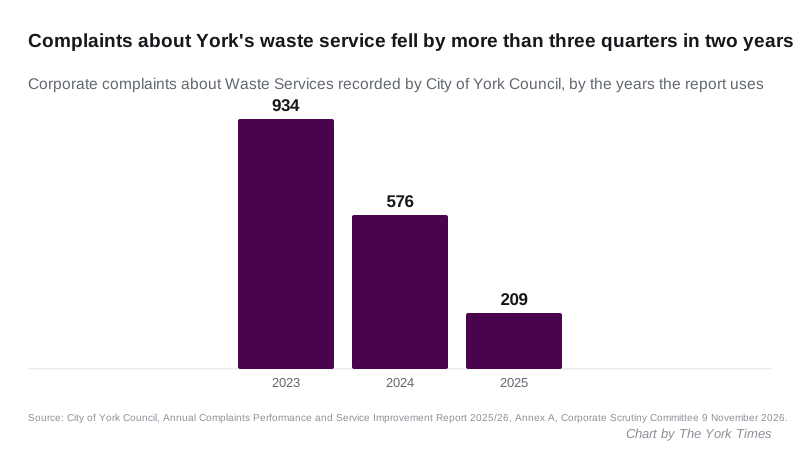
The most common upheld complaints were about:
- missed assisted bin collections
- housing repairs, including damp and mould
- missed collections
- damaged or missing bins
The report says complaints about medical waste collections are growing. It says the people most affected by repeat problems are older, disabled and vulnerable households.
Part of the fall is because more problems are now sent back to the service to fix before they count as a complaint. The report says these “premature” complaints rose from 1,394 in 2023 to 3,588 in 2025. Waste was also the subject of 1,125 everyday service requests, almost a third of the total.
Housing repairs rising
Complaints about housing repairs and maintenance went the other way, from 88 in 2023 to 156 in 2025. The report says new legal duties on landlords are likely to have contributed.
The Housing Ombudsman made 15 findings on the council’s homes in the year:
- 8 maladministration
- 3 service failure
- 1 reasonable redress
- 1 no maladministration
- 1 outside its jurisdiction
That gives a maladministration rate of 79%, against 67% for landlords of a similar size and type. The Ombudsman ordered £3,150 in compensation across 11 orders. The council is landlord of 8,299 homes. The report notes that from October 2025 the Ombudsman began examining complaint handling in every case it investigates, so this year’s rate is not directly comparable with earlier years.
Where the compensation went
The £16,558.58 paid in financial remedies broke down like this:
| Service | Paid |
|---|---|
| SEND (special educational needs) | £9,650 |
| Housing maintenance and repairs | £5,490 |
| Planning and environment | £500 |
| Adult safeguarding | £503.58 |
| Waste | £200 |
| Council Tax | £115 |
| Housing management | £100 |
The report says 58% of the total was paid on a single complaint. We reported one SEND case, a non-verbal boy left without Makaton support, last week.
Social care complaints up
Statutory complaints about adult social care doubled, from 26 to 53. The report says they were mainly about charging, delays in assessments and poor communication. All were answered within six months.
Children’s social care complaints rose from 27 to 39, with the biggest increase in safeguarding.
Complaints written with AI
The report says there has been a rise in complaints written with artificial intelligence tools. It says they often cite “incorrect legal arguments” and can be “un-necessarily lengthy”, which slows down the council’s response. The council has published guidance on using AI tools to complain.
What it means for you
- To complain: the council asks three questions of every complainant: what went wrong, what impact it had on you, and what it can do to put things right. Answering those clearly is the quickest route to a reply.
- Report it first: a missed bin or a pothole reported for the first time is a service request, not a complaint. Use the council’s missed bin form before complaining. Our York bin collection days page has the schedule.
- If you are still unhappy: after the council’s final stage, you can go to the Local Government and Social Care Ombudsman, or the Housing Ombudsman if you are a council tenant.
Have your say